
How to safely package a homogenizer?
As a precision core equipment in the industrial production field, the safe transportation of high-pressure homogenizers is directly related to the continuity and stability of the customer’s production chain. Establishing and implementing a six-level responsibility control system of “equipment cleaning – component protection – wooden box assembly – fixed packaging – cling film wrapping – inspection and review”. Each link has clear rights and responsibilities and progresses step by step. The specific implementation norms are as follows:
The first step: Factory inspection and traceability retention
Before leaving the factory, the equipment shall complete no less than 3 hours of no-load/load trial operation verification, during which the full-process video recording and all-round appearance image collection shall be completed simultaneously. Image acquisition should cover all facades and key components of the equipment, and a complete factory traceability file should be established to provide a basis for subsequent quality traceability.
Step 2: Customized wooden box packaging and reinforcement
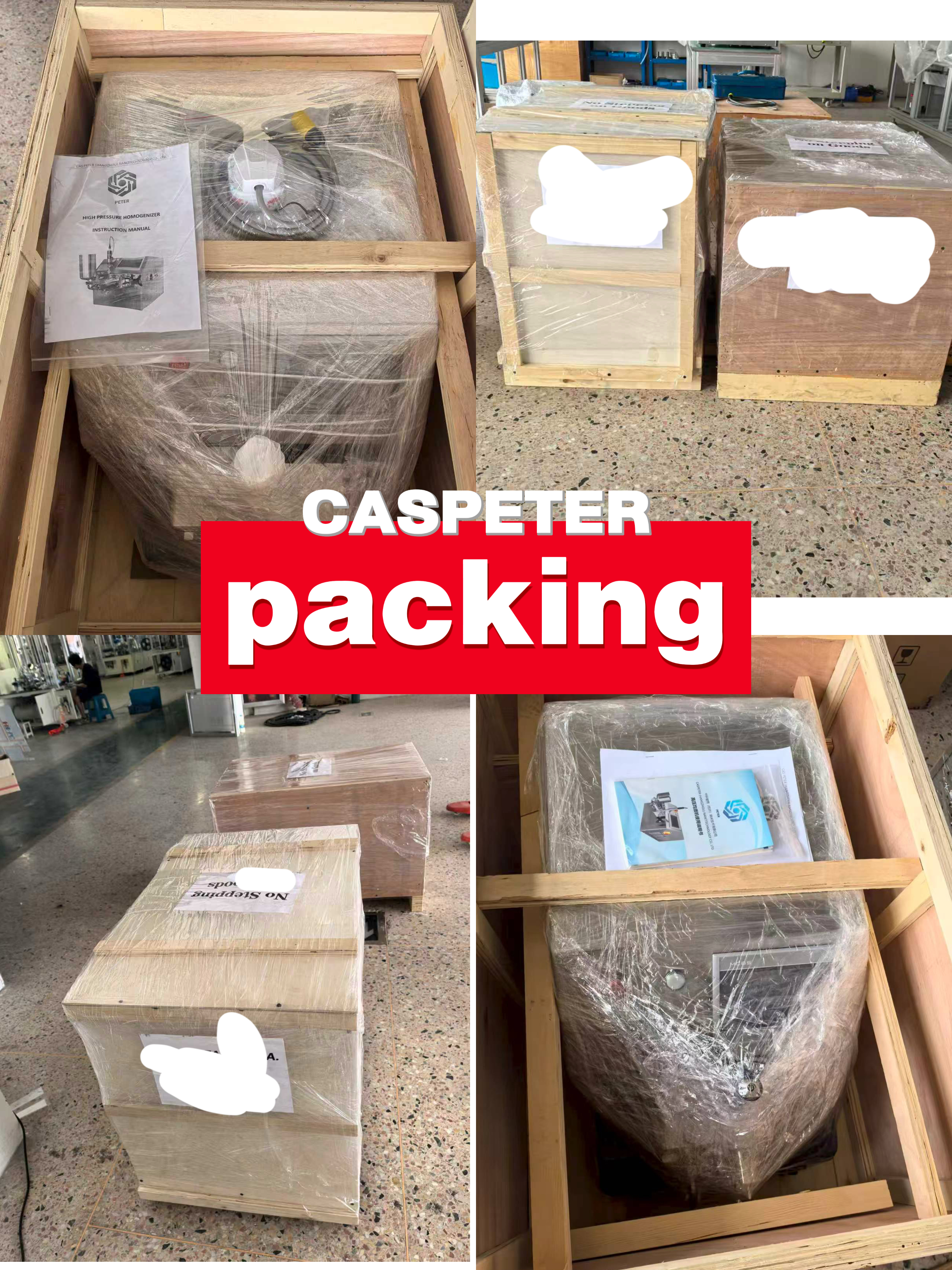
Customized special wooden crates are made based on the precise dimensions of the equipment, and standardized reinforcement processes are implemented: “3 horizontal + 2 vertical” wooden strips are used for reinforcement, and anti-theft bolts are used to lock the joints to prevent loosening. Adjustable shockproof wooden blocks are embedded around the inner side of the box. After being precisely aligned with the equipment base, they are securely locked to ensure that the equipment achieves “zero displacement” protection inside the box. After the entire packaging process is completed synchronously, multi-directional image records are made to retain the basis for packaging quality verification.
Step 3: Wrap and seal with cling film
Following the standardized winding process of “from bottom to top, first the main body and then the corners”, the base of the wooden box should be wound upwards from the bottom for no less than 3 turns, with an overlap rate of 100% for each turn, ensuring that the base and the seams of the box are in a sealed state and effectively blocking the influence of external environments such as moisture and dust.
CASpeter has always been supported by a standardized system, from institutional norms to process implementation, from hierarchical control to layer-by-layer verification, integrating the core requirements of “rigorous safety and traceability” throughout the entire process of transfer and protection to ensure the safe and smooth delivery of equipment.
Post time: Dec-02-2025